Last updated October 15, 2026
How to Hire a ADU Contractor in Torrance: A Step-by-Step Guide
Most homeowners in Torrance hire an ADU contractor based on a website photo gallery and a handshake. That is the expensive way to do it. The city of Torrance keeps a public record of every permit any contractor has ever pulled here, and you can look it up yourself in under four minutes. This guide walks you through the exact steps to verify a contractor before you sign anything, the questions that disqualify a bidder on the spot, and how to read a fixed-price contract so the number you approve is the number you pay. For more guides & resources, see our blog.
Quick Answer
Hiring an ADU contractor in Torrance comes down to three verifiable facts: an active CSLB license with bond coverage, a permit history on file at Torrance Building and Safety that shows completed ADU or addition work (see our Room Addition Contractor Maintenance Checklist for Torrance Homeowners), and a written fixed price before any money changes hands. If a contractor resists any one of those three, remove them from your list and move on.
Table of Contents
- Step 1: Verify the CSLB License and Bond Coverage
- Step 2: Pull the Permit History at Torrance Building and Safety
- Step 3: Run the Bid Meeting Like a Job Interview
- Step 4: Understand Fixed-Price vs. Time-and-Materials Contracts
- Step 5: Compare Bids That Look Different on Paper
- Torrance-Specific Factors That Change Your ADU Budget
- Prefab vs. Conventional: Which Build Method Fits Your Lot
- Common Mistakes to Avoid
- When to Call a Professional
- Frequently Asked Questions
- The Bottom Line
Step 1: Verify the CSLB License and Bond Coverage Before the First Meeting
Before you let anyone walk your property, pull their license. The California Contractors State License Board keeps a free public database at cslb.ca.gov. Type in the license number and you will see the license status, the classification (for ADU work you want a B – General Building classification), the license issue date, and whether the license is active, suspended, or expired. You will also see the bond status. California requires contractors to carry a $25,000 contractor’s bond, and that bond must be current. If the bond shows as canceled or inactive, the contractor cannot legally pull permits in Torrance.
Here is the exact sequence we recommend:
- Go to cslb.ca.gov and click “Check a License.”
- Enter the license number the contractor gave you. If they will not give you a license number before a meeting, that is your first disqualifier.
- Confirm the license classification is B – General Building. A C-6 cabinet contractor or a C-27 landscaper cannot legally build an ADU.
- Check the bond status line. It should read “Active” with a bond company name.
- Look at the “Workers’ Comp” line. If it says “Exempt” and the contractor shows up with a crew of three, walk away. That exemption means they have no employees; a crew means they are operating without workers’ comp insurance, and if someone gets hurt on your property, the claim lands on your homeowner’s policy.
- Note the license issue date. A license issued six months ago does not automatically disqualify someone, but it means the business entity is new. Ask what the owner did before. In our experience in Torrance, contractors who change business names every few years are usually running from something.
Do not skip this step because a contractor seems “nice.” A revoked license, a bonded-but-suspended license, or no license at all means the city will not issue a permit for your project, and you will have no recourse through the CSLB if the work fails. The ADU Builders in Torrance we respect all carry active licenses and current bonds, and none of them mind you checking. The ones who mind are the ones you should not hire.
Step 2: Pull the Permit History at Torrance Building and Safety
Torrance Building and Safety keeps a searchable permit database, and it is public record. Most homeowners never look at it. That is a mistake, because a contractor’s permit history tells you more than any review site ever will. You can access it through the city’s online permit portal or by calling Building and Safety at (424) 358-3068 during business hours. Some searches can be done online; others require a records request form. Either route works.
What you are looking for:
- Completed ADU or addition permits. Not just “issued” permits. A permit that was issued and then expired without a final inspection is a red flag. You want a record of permits that reached “finaled” status, meaning the work passed inspection.
- Volume within Torrance specifically. A contractor with 40 permits in Riverside and one in Torrance does not know Torrance code. Torrance has specific ADU regulations, setbacks, and a separate accessory structure ordinance that differs from neighboring cities. You want someone who has pulled multiple permits here.
- Recent activity. A contractor whose last Torrance permit was in 2019 may not be current on the city’s latest ADU ordinance updates, including the 2024 state law changes that expanded ADU allowances.
- The address match. When you find permits, verify the contractor’s name on the permit matches the name on the contract you will sign. Subcontracting the permit pull to another GC is legal but changes who is legally responsible for the work.
One thing we tell every homeowner who calls us: ask the contractor for three recent Torrance addresses where they pulled permits, then verify those addresses in the city database yourself. A contractor who hesitates to give you addresses is hiding something. A contractor who hands you the list without blinking has nothing to hide.
Step 3: Run the Bid Meeting Like a Job Interview
The bid meeting is not a sales presentation. It is a job interview, and you are the one hiring. The contractor works for you, not the other way around. And in Torrance right now, where ADU demand is high and good crews are booked out, some contractors act like they are doing you a favor by showing up. You are paying six figures for this project. You ask the questions. They answer. Anyone who cannot answer clearly does not get the job.
Here are the questions to ask, and the answers that should disqualify a contractor on the spot:
- “Will you pull the permit under your license?” The only acceptable answer is yes. If the contractor asks you to pull the permit as an owner-builder, that shifts liability onto you. There are legitimate owner-builder scenarios, but if a licensed contractor suggests it to avoid permit costs or inspections, that is a disqualifier.
- “What is your fixed price, and what specific line items does it include?” If they say “we will figure that out as we go” or “it depends,” that is a time-and-materials arrangement dressed up as a bid. Disqualify.
- “When can you start, and what is your completion timeline?” A vague answer is fine at this stage; a refusal to put a start date in writing after you sign is not.
- “Who is the project lead on my job, and will I have their phone number?” If the person you are talking to will not be on site and will not give you the name of the person who will, prepare for the project to fall through the cracks between sales and production.
- “What is your change order process, in writing?” Every ADU has surprises. The question is whether the contractor has a formal, written change order process or whether they just say “we will handle it.” A contractor without a written process changes prices verbally, and you find out at the final invoice.
- “What warranty do you put on the work, and is it on paper?” California requires a one-year workmanship warranty on new construction. But the law sets the floor. Ask what the contractor offers beyond the legal minimum. Some contractors in Torrance put their warranty in writing with specific terms. Others point to the statute and hope you never call.
One note from our own work in Torrance: the best contractors answer these questions before you ask. They hand you a written price, a written timeline, and a written warranty. That is the Fielding ADU Torrance home approach, and it is also the approach of every contractor we would recommend to our own families.
Step 4: Understand Fixed-Price vs. Time-and-Materials Contracts
A time-and-materials contract means you pay for every hour worked and every material purchased, whatever those totals end up being. The contractor has no financial incentive to finish efficiently. A fixed-price contract means the contractor agrees to complete defined scope for a defined number, and any change requires your written approval. For a Torrance ADU, where projects routinely run $150,000 to $350,000, the difference between those two contract types can be tens of thousands of dollars.
Here is what a fixed-price ADU contract must include to be enforceable and to protect you:
- A written scope of work. This is the document that defines what is included. It should list every major component: foundation type, framing, roofing, windows, doors, electrical panel size and location, plumbing fixtures, HVAC system, insulation, drywall, paint, flooring, exterior siding. If it is not written, it is not included.
- Allowances spelled out with dollar amounts. Items like “flooring allowance” need a number, not a phrase. Allowances are the number one place contractors underbid to win the job, then hit you with the difference later.
- A payment schedule tied to milestones, not dates. Payments should follow completed work: foundation poured, framing passed inspection, rough plumbing and electrical passed, drywall completed, final inspection passed. Never pay a large deposit up front. California caps the down payment at $1,000 or 10% of the contract price, whichever is less.
- A change order clause. This says any change to scope or price must be in writing and signed by both parties. If the contractor does the work first, then tells you it cost more, you are not obligated to pay it without a signed change order.
- The warranty in writing. Not just “one-year warranty” in the boilerplate. The actual terms: what does it cover, how long, and what is the process for a claim. The Garrison Standard, which Fielding ADU Builders operates under, puts this on paper: 365 days of written coverage on workmanship defects, and if something fails, we return and correct it at no charge.
A contractor who refuses to put a fixed price in writing before work starts is telling you, in advance, that the number will move. Believe them. The written price is not a formality. It is the only thing between you and a final invoice you did not authorize. Our owner Reed Calloway has built the company on that principle since day one, and it is non-negotiable on every ADU and Room Addition Contractor in Torrance project we run.
Step 5: Compare Bids That Look Different on Paper
Three contractors give you three numbers: $165,000, $210,000, and $240,000. The instinct is to hire the cheapest. That instinct is wrong. The number on a bid means nothing until you compare what each bid includes. A low bid is only a good deal if it covers the same scope as the higher bid. More often, the low number is low because something is missing.
Here is what to look for when two bids are far apart:
- Foundation scope. Does the lower bid include excavation, grading, form work, and the same foundation type? A slab-on-grade ADU costs less than a raised foundation, but if your lot in Torrance slopes or has drainage issues, the cheaper foundation may not meet code.
- Utility connections. Connecting the ADU to sewer, water, and electrical service means trenching across your yard. Some low bids price only the ADU shell and leave utility connections as “owner responsibility.” Trenching and connections can run $10,000 to $25,000, depending on the distance from the main lines.
- Electrical panel capacity. Many Torrance homes have 100-amp or 125-amp panels. An ADU with a kitchen and a mini-split HVAC may require a 200-amp service upgrade. That is $4,000 to $8,000 on its own. Does each bid include it, or does the low bid assume you will figure it out?
- Finish level. One bid prices builder-grade cabinets, laminate counters, and vinyl plank floors. Another prices custom cabinets, quartz, and engineered hardwood. The finish allowance explains a $30,000 spread. Compare the allowances, not just the totals.
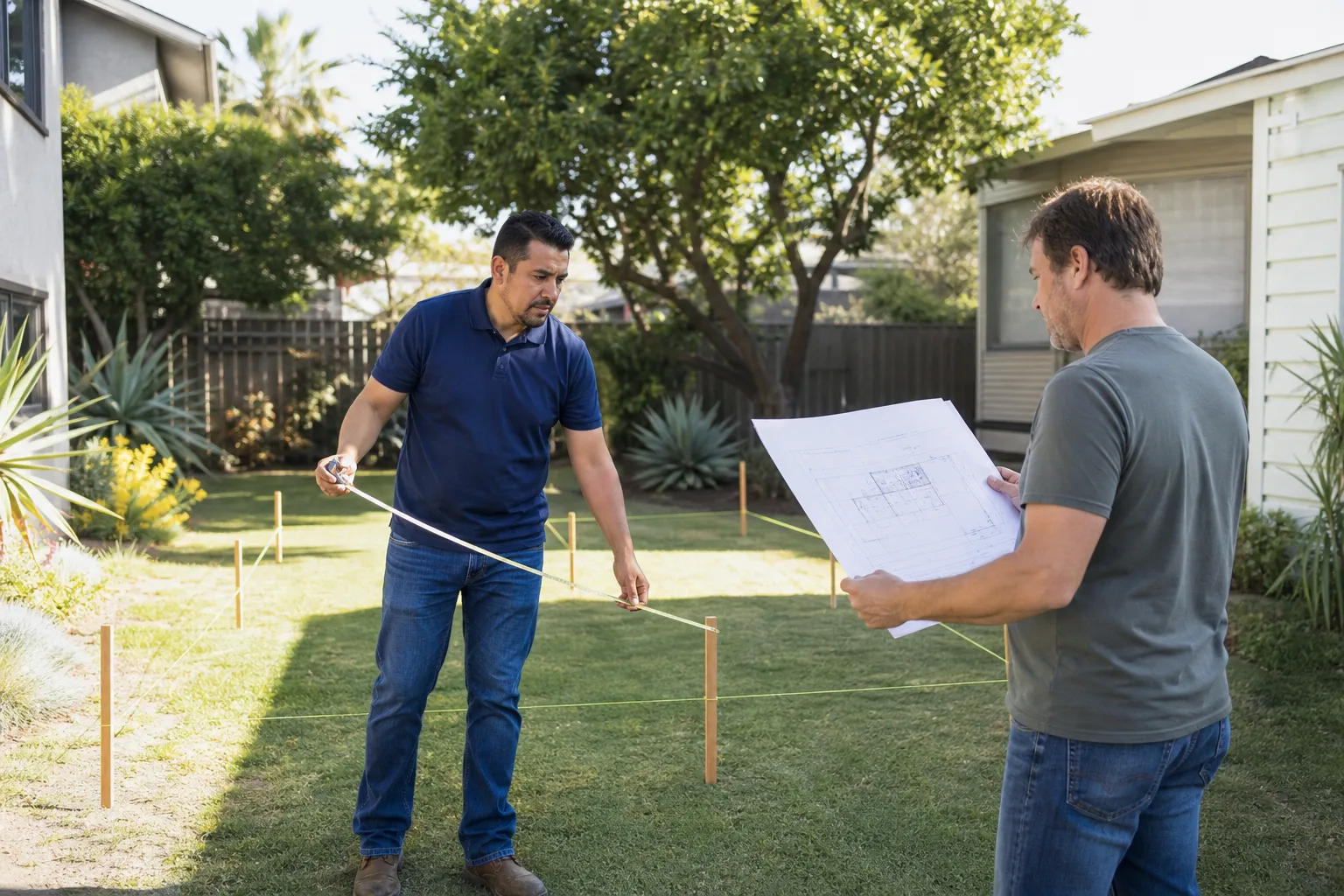
- Site access. If your backyard is tight, with fence access only and no room for heavy equipment, the job takes longer and costs more. A contractor who has walked your lot in Torrance and priced for difficult access gave you an honest number. A contractor who quoted from Google Maps gave you a guess.
- Permit and inspection fees. Torrance charges plan check fees, permit fees, and school impact fees for ADUs. Make sure every bid includes a line item for city fees, and check that the amounts match. A bid that omits city fees is $10,000 to $15,000 ahead of where it should be, and you will pay the difference later.
In our experience in Torrance, the right comparison is not between three numbers. It is between three scopes. Line up the bids side by side, find the missing line items in the low number, and you will understand exactly where the “savings” comes from. Sometimes the savings is legitimate and the contractor just runs leaner. More often, the savings is a scope gap you will pay for later. The Garrison Code we run on is simple: show up in the window, price in writing, by the book, leave it clean, stand behind it for a year. That means the number we hand you is the number on the final invoice, and the scope we write is the scope we build.
Torrance-Specific Factors That Change Your ADU Budget
Torrance is not Los Angeles, and it is not Redondo Beach. The city has its own ADU ordinance, its own setbacks, and its own plan check process. If a contractor tells you “ADUs are ADUs, the rules are the same everywhere,” that is a disqualifier. The rules are not the same. Here are the Torrance factors that move your budget:
- Setback requirements. Torrance requires rear and side yard setbacks for detached ADUs, though the exact numbers depend on your zone. Some lots qualify for reduced setbacks under state law; others need a setback variance (the city’s written permission to build closer to the property line than the standard rule allows). A variance adds plan check time and sometimes a hearing. That is time and money.
- Lot size and FAR limits. Floor Area Ratio limits how much of your lot can be covered by structures. Adding an ADU to a lot that is already near its FAR cap can trigger additional review or require design changes to the main house. A contractor who knows Torrance zoning will flag this on the first walk.
- Soil conditions. Parts of Torrance sit on expansive soils that swell and shrink with moisture. Some ADU sites need soil testing and engineered foundation design, which costs $3,000 to $7,000 up front but prevents slab cracks later. This is not optional; the structural engineer and the city will require it where conditions warrant.
- Coastal proximity. South Torrance neighborhoods near the coast can face additional design review for height, materials, and even exterior color. The closer you get to the bluffs, the more the city wants to see drawings that respect neighborhood character.
- Utility depth and age. Older Torrance neighborhoods with 1950s-era infrastructure sometimes have sewer laterals that need replacement before the ADU can connect. That is a buried cost, sometimes literally. A contractor with Torrance experience knows to camera the line before pricing.
- Parking rules. Some Torrance ADUs require an additional parking space, though state law has reduced this requirement in many cases for ADUs near transit or within certain distances of public transportation. Confirm your specific parking requirement before locking in a design.
None of this is exotic. It is just Torrance. A contractor who has built here knows it, prices it, and explains it. A contractor who has not built here will find out about it during plan check, and the change orders will start arriving. We have seen homeowners in the North Torrance and Walteria neighborhoods come to us after another contractor’s plan check failed three times, and by then they are six months in with no permit and a signed contract they can no longer undo.
Prefab vs. Conventional: Which Build Method Fits Your Lot
One decision that changes everything about your ADU timeline and budget is the build method. Torrance homeowners now have a real choice between conventional stick-built construction and prefab or modular ADU platforms. Both produce a legal, permitted ADU. They differ in cost, schedule, site constraints, and design flexibility.
Conventional construction means the ADU is framed on site from lumber, sheathed, roofed, and finished by subs working in sequence. It is the most flexible approach. It handles odd-shaped lots, tight access, and custom designs better than any prefab system. It also takes the longest: 6 to 10 months from permit issuance to final inspection on a typical Torrance ADU. Materials get delivered, crews come and go, and weather can slow the schedule.
Prefab and modular platforms, by contrast, build most of the structure in a factory and deliver panels or modules to your lot for assembly. This shortens on-site time significantly and reduces some weather risk. We work with the major platforms homeowners are already researching online: Abodu, Cover, Dvele, Mighty Buildings, Boxabl, and Plant Prefab. Each has a different price point, a different level of finish, and different site requirements. Mighty Buildings, for instance, uses 3D-printed composite panels and needs relatively flat access for delivery. Boxabl units are highly standardized and cost-effective but offer less design flexibility. Tuff Shed-style structures sit at the opposite end of the spectrum, a panelized option that can work for a simple studio ADU where budget is the primary constraint.
The honest way to frame the choice: prefab is not cheaper than conventional in most Torrance cases, but it is often faster and more predictable. The right answer depends on your lot, your budget, and how much you care about customizing the floor plan. A contractor who can build conventionally and also work fluently with prefab platforms can give you an honest comparison rather than steering you toward whichever method they happen to sell. That is the position we have built at Fielding ADU Builders, and it is why we routinely present both options side by side in our written estimates.
Common Mistakes to Avoid
- Hiring based on a photo gallery. Photos show finished work; they do not show whether the permit closed, whether the homeowner was paid-up happy or just quiet, or whether the contractor built it or just marketed it. Check the permit record at Torrance Building and Safety instead. That record cannot be faked.
- Signing a time-and-materials contract. The contractor has no incentive to finish, and every incentive to run the clock. In Torrance, where ADU labor is tight, a T&M contract can turn a six-month job into an eighteen-month open checkbook.
- Paying too much up front. California law caps the down payment at $1,000 or 10% of the contract price, whichever is less. A contractor who asks for 30% down to “order materials” is violating state law, and that is the kind of contractor who disappears after the framing package arrives.
- Skipping the plan check review. The plan check process at Torrance Building and Safety exists to catch code problems before they are built into your walls. Skipping it because it adds 6 to 10 weeks is how homeowners end up with an unpermitted ADU that cannot be insured, financed, or sold.
- Choosing the cheapest bid without comparing scope. The low bid is low because something is missing. Find the missing line items before you sign. The money you “save” on day one is the change order on day 200.
- Not asking who will be on site. The person who sells you the ADU is often not the person who builds it. If you do not know the name of the project lead and you cannot reach them by phone, you will be managing the job yourself over email with a company that has moved on to the next sale.
- Assuming the warranty is automatic. California law requires a one-year workmanship warranty, but enforcing a statutory warranty means taking someone to court. A warranty that is written, specific, and backed by a company that answers the phone is a different thing entirely. Ask for it on paper before you sign.
When to Call a Professional
You should call an ADU contractor the moment you have a serious intent to build, not after you have already designed the unit and bought materials. The earlier the contractor is involved, the more useful the input on lot constraints, utility routing, and Torrance code requirements will be. Specific triggers: you have a budget number in mind and want to know if it is realistic for Torrance; you have a lot with slope, drainage, or access issues; you have received one bid and want a second opinion before signing; or you tried the owner-builder route and realized the city’s plan check requirements are beyond what you want to manage alone. Fielding ADU Torrance offers free estimates in Torrance, call (424) 358-3068 to schedule a site walk and get a written price before you commit to anything.
Frequently Asked Questions
A detached one-bedroom ADU in Torrance typically runs $150,000 to $250,000 for conventional construction, while a garage conversion typically runs $80,000 to $150,000 before permit fees, depending on finish level, utility work, and site conditions. See our ADU Cost Breakdown: The Torrance Homeowner’s Reference for 2026 for detailed pricing. Call (424) 358-3068 for an exact quote on your specific lot, estimates are free.
Plan check at Torrance Building and Safety typically takes 6 to 10 weeks for a complete ADU submittal, assuming the plans are drawn correctly and no revisions are required. Construction then adds 4 to 8 months for conventional builds; prefab platforms can shorten the on-site phase significantly.
Yes, you need the license number to look up the contractor on the CSLB website. Ask for the number before the first meeting. If they will not provide it, that is a disqualifier, and you should not let them walk your property.
Yes, California allows owner-builder permits, but the city holds you to the same code standards as a licensed contractor, and you assume all liability for the work. If you hire workers without pulling a permit under a license, you are the legally responsible party, and your homeowner’s insurance may not cover you.
Check your contract first. If the additional cost is not covered by a signed change order, you are generally not obligated to pay it under a fixed-price contract. If you are on a time-and-materials contract, the extra cost is likely valid and you are exposed. This is why the contract type matters more than any other document you sign.
Yes, we work with Abodu, Cover, Dvele, Mighty Buildings, Boxabl, and Plant Prefab, as well as conventional construction using James Hardie siding and Tuff Shed-style structures. That means we can match the build method to your budget and lot rather than selling you one approach. Call (424) 358-3068 to talk through your options.
The Bottom Line
Hiring an ADU contractor in Torrance is a verification process, not a leap of faith. You check the CSLB license and bond status, you pull the permit history at Torrance Building and Safety, you run the bid meeting with real questions about fixed pricing and change orders, and you compare bids by scope rather than by total. The homeowners who follow those steps end up with a permitted ADU at a known price. The ones who skip the steps end up with a foundation poured and a contractor who no longer answers. Reed Calloway and the Fielding ADU team work to The Garrison Standard: show up in the window, price in writing, by the book, leave it clean, stand behind it for a year. That is what we offer on every Garage Conversion Contractor in Torrance project we run. Verify us the same way we tell you to verify everyone else. The records are public.
Written by Reed Calloway, Owner at Fielding ADU Torrance, serving Torrance since 2006.